Legal basis: a guide for employers in Kosovo
An employer’s duties under Law No. 04/L-161, summed up in 12 criteria that can be checked on site, from risk assessment to the labour inspector’s measures.
1 / 24
Click or drag a page corner to turn it. On a keyboard: left and right arrows.
Guide text (English translation)
Page 1
HEALTH AND SAFETY AT WORK
Legal basis
A guide for employers in Kosovo
Law No. 04/L-161 · hsk-ks.com
Page 3
The employer’s responsibility
Law No. 04/L-161, Articles 5, 9 and 13
The law makes the employer responsible for the safety and health of employees in every aspect of work. This guide sums up those duties in 12 criteria that can be checked on site.
External services: When the employer engages an outside expert or institution, the employer oversees the quality of their work. Responsibility does not pass to the provider.
Employees’ rights: Employees and their representatives take part in discussing the measures. If they judge them inadequate, they may turn to the inspector (Article 19).
Contents
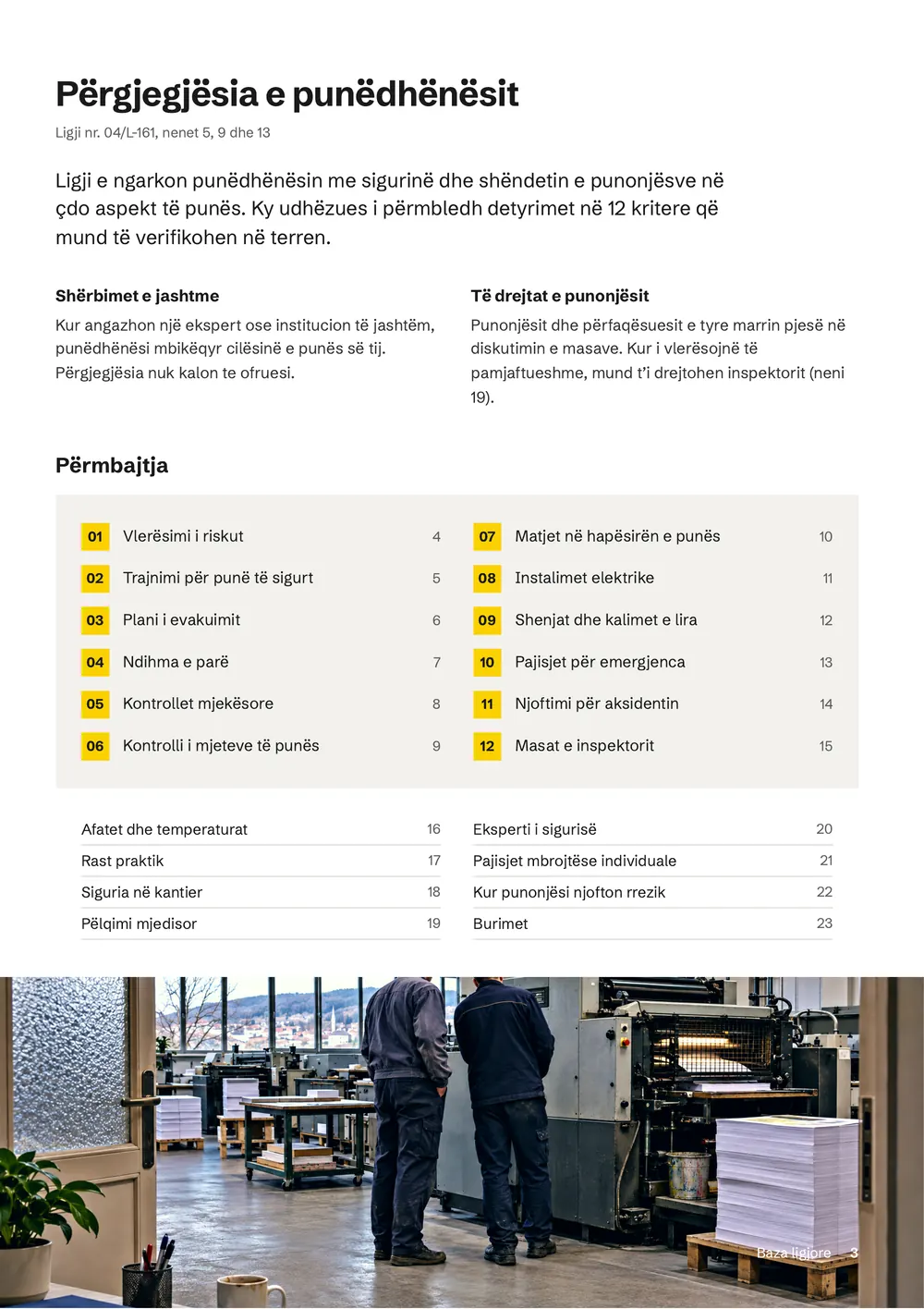
01 Risk assessment (4) · 02 Training for safe work (5) · 03 Evacuation plan (6) · 04 First aid (7) · 05 Medical checks (8) · 06 Inspection of work equipment (9) · 07 Workplace measurements (10) · 08 Electrical installations (11) · 09 Signs and clear routes (12) · 10 Emergency equipment (13) · 11 Reporting an accident (14) · 12 The inspector’s measures (15)
Intervals and temperatures (16) · Case study (17) · Safety on construction sites (18) · Environmental consent (19) · The safety expert (20) · Personal protective equipment (21) · When an employee reports a hazard (22) · Sources (23)
Page 4
01 · Risk assessment
Law No. 04/L-161, Articles 5, 12 and 16 · MLSW Regulation 02/2021
The employer assesses the risk for every workplace, draws up the document and carries out the measures that follow from it.
Who carries it out? Qualified professionals, from within the company or engaged from outside (Article 16).
What does it contain? Technical, organisational and hygiene measures suited to the actual conditions (Article 12).
Order of measures (Article 7): 1. Eliminate at source; 2. Collective protection; 3. Individual protection; 4. Check the effect.
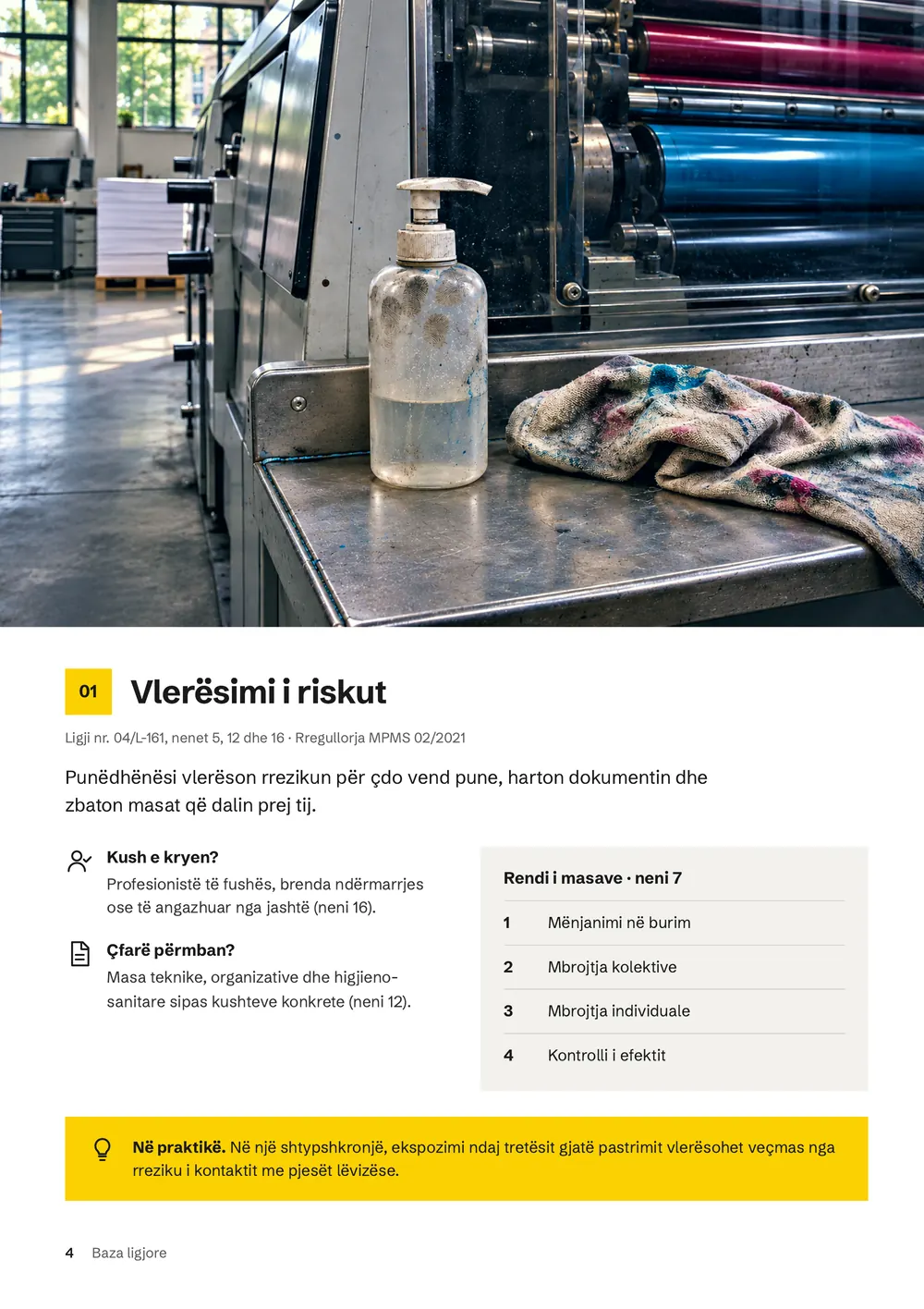
In practice. In a print shop, exposure to solvent during cleaning is assessed separately from the risk of contact with moving parts.
Page 5
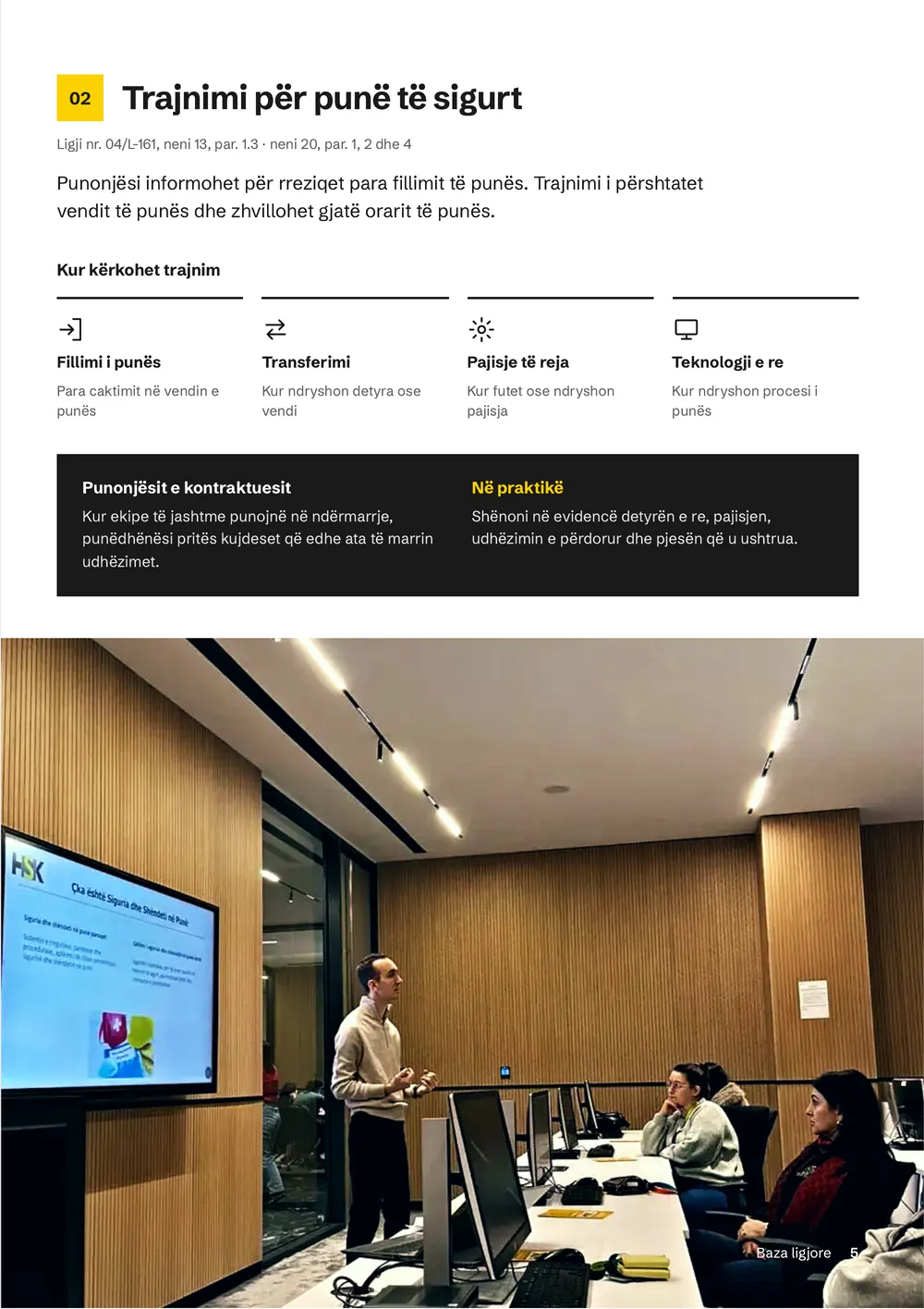
02 · Training for safe work
Law No. 04/L-161, Article 13, para. 1.3 · Article 20, paras. 1, 2 and 4
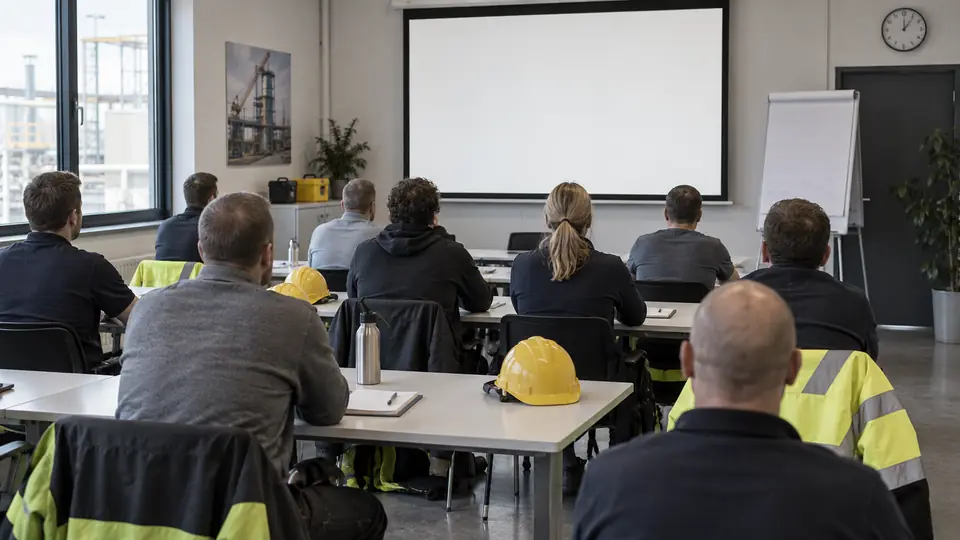
The employee is informed about the risks before starting work. Training is tailored to the workplace and takes place during working hours.
When training is required: Starting work, before being assigned to the workplace. Transfer, when the task or place changes. New equipment, when equipment is introduced or changed. New technology, when the work process changes.
Contractors’ employees: When outside teams work on the premises, the host employer makes sure they also receive the instructions.
In practice: Record the new task, the equipment, the instruction used and the part that was practised.
Page 6
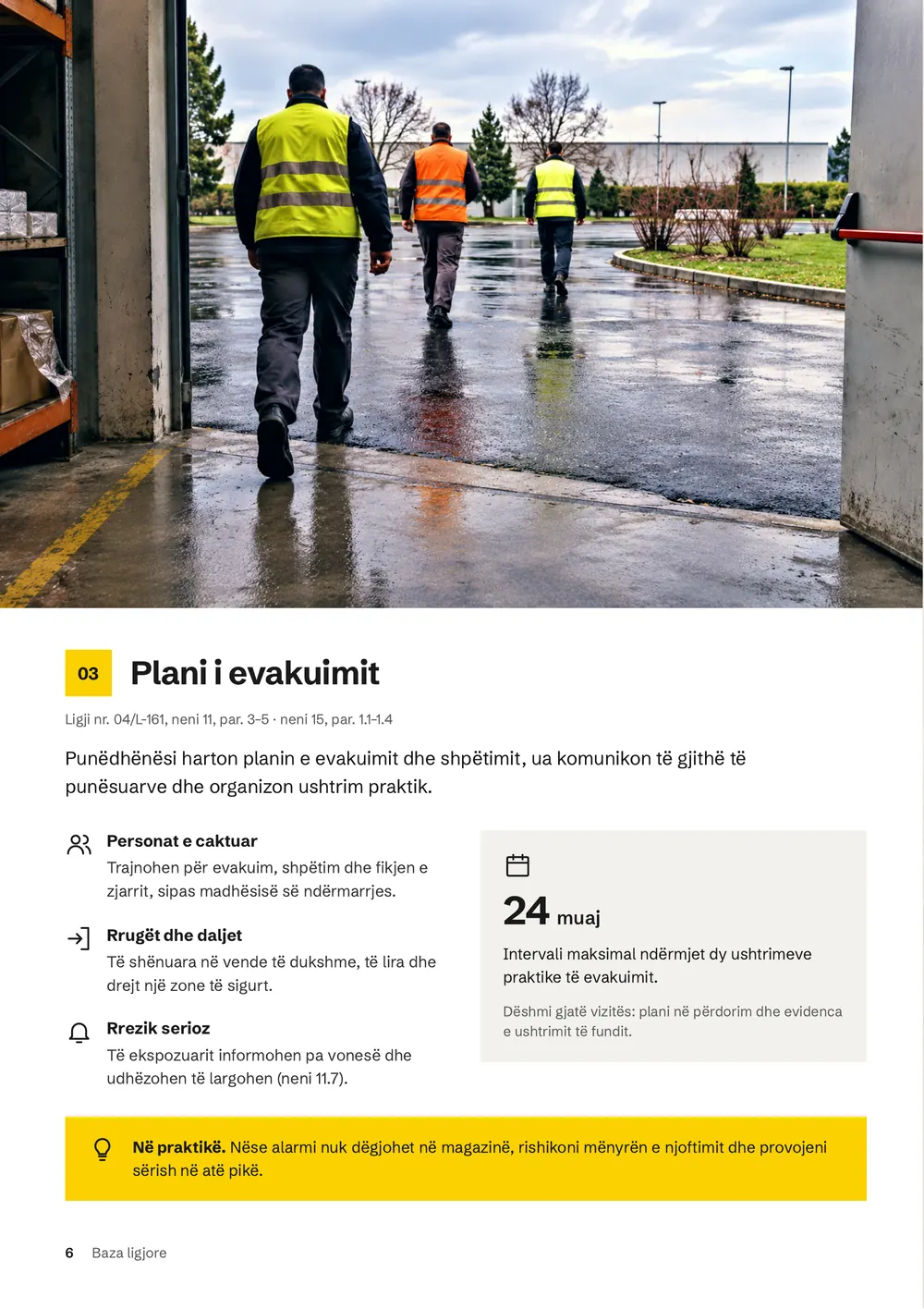
03 · Evacuation plan
Law No. 04/L-161, Article 11, paras. 3–5 · Article 15, paras. 1.1–1.4
The employer draws up the evacuation and rescue plan, communicates it to all employees and organises a practical drill.
Designated persons: Trained in evacuation, rescue and firefighting, according to the size of the company.
Routes and exits: Marked in visible places, kept clear and leading to a safe area.
Serious danger: Those exposed are informed without delay and instructed to leave (Article 11.7).
24 months: The longest interval between two practical evacuation drills. Evidence during a visit: the plan in use and the record of the last drill.
In practice. If the alarm cannot be heard in the warehouse, review how people are alerted and test it again at that spot.
Page 7
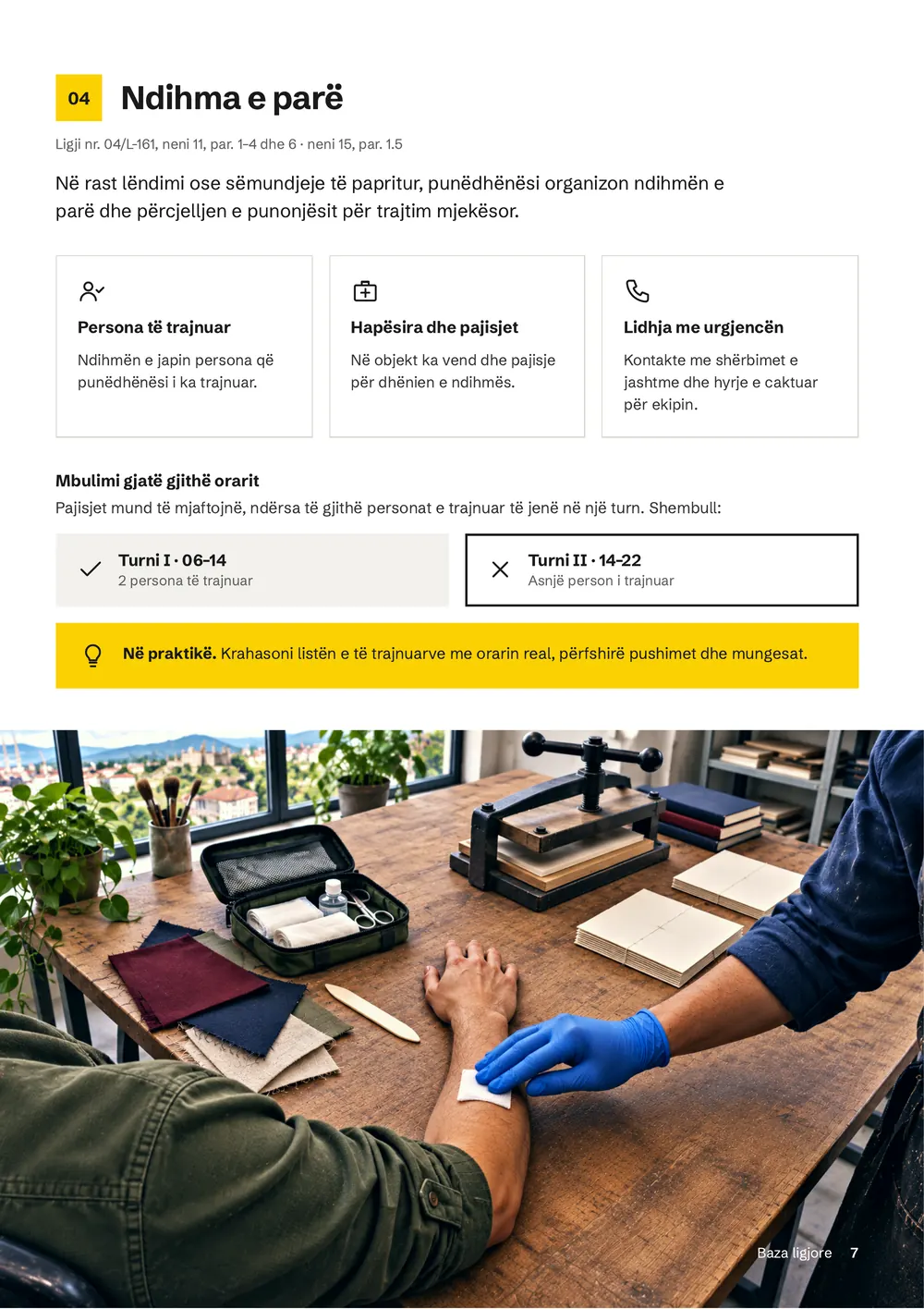
04 · First aid
Law No. 04/L-161, Article 11, paras. 1–4 and 6 · Article 15, para. 1.5
In the event of an injury or sudden illness, the employer organises first aid and the employee’s transfer for medical treatment.
Trained people: First aid is given by people the employer has trained.
Space and equipment: The premises have a place and equipment for giving first aid.
Link to emergency services: Contacts with outside services and a designated entrance for the team.
Cover across all working hours: The equipment may be sufficient while all the trained people are on one shift. Example: Shift I (06–14): 2 trained people. Shift II (14–22): no trained person.
In practice. Compare the list of trained people with the actual rota, including breaks and absences.
Page 8
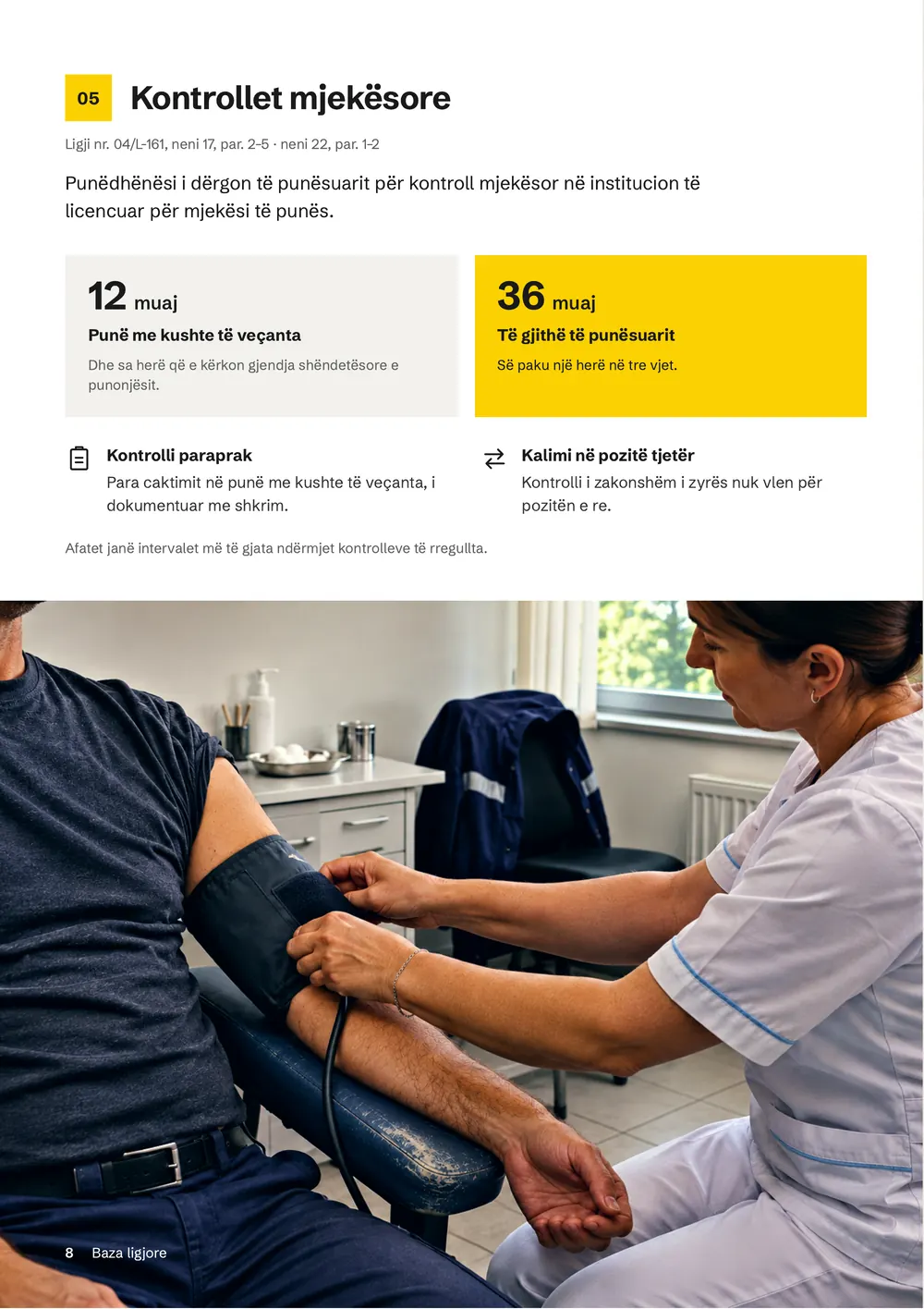
05 · Medical checks
Law No. 04/L-161, Article 17, paras. 2–5 · Article 22, paras. 1–2
The employer sends employees for medical checks to an institution licensed in occupational medicine.
12 months: Work under special conditions. Also whenever the employee’s health requires it.
36 months: All employees. At least once every three years.
Pre-placement check: Before assignment to work under special conditions, documented in writing.
Moving to another position: The usual office check does not cover the new position.
The intervals are the longest allowed between regular checks.
Page 9
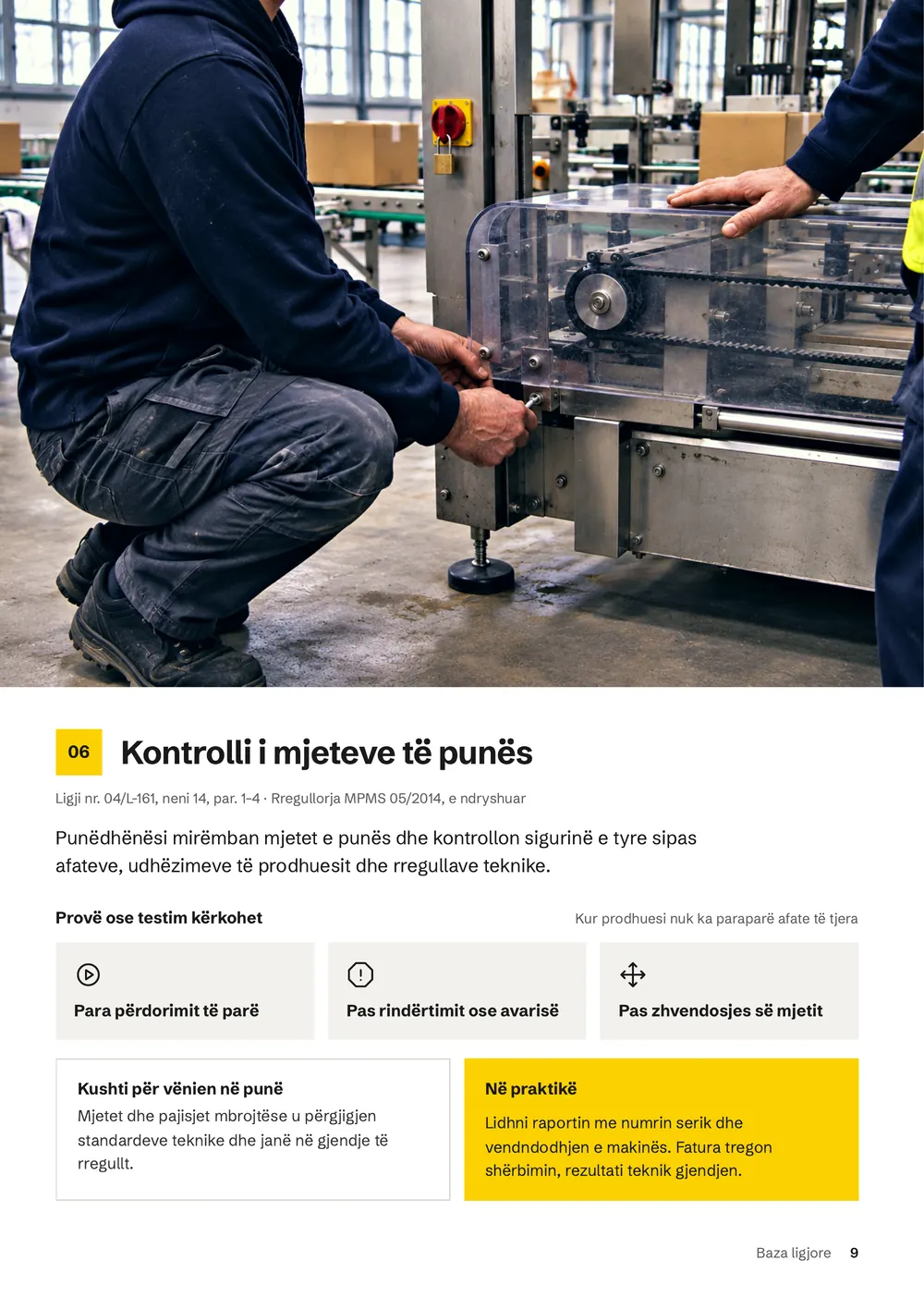
06 · Inspection of work equipment
Law No. 04/L-161, Article 14, paras. 1–4 · MLSW Regulation 05/2014, as amended
The employer maintains work equipment and checks its safety according to the set intervals, the manufacturer’s instructions and technical rules.
A test or inspection is required (where the manufacturer has not set other intervals): before first use; after rebuilding or a breakdown; after the equipment is moved.
Condition for putting into service: The equipment and protective devices meet technical standards and are in good order.
In practice: Link the report to the serial number and location of the machine. The invoice shows the service; the technical result shows the condition.
Page 10
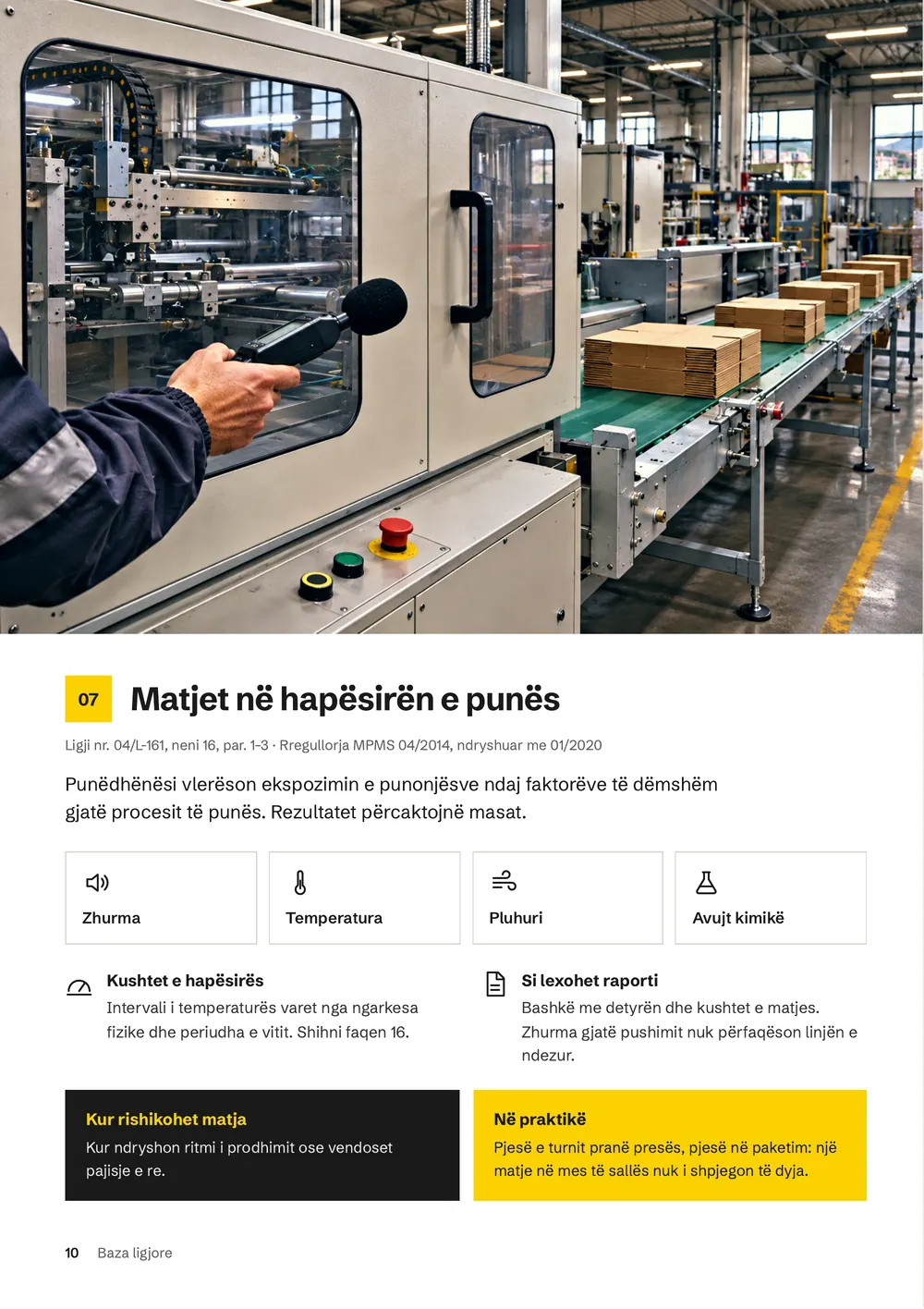
07 · Workplace measurements
Law No. 04/L-161, Article 16, paras. 1–3 · MLSW Regulation 04/2014, amended by 01/2020
The employer assesses employees’ exposure to harmful factors during the work process. The results determine the measures.
Noise · Temperature · Dust · Chemical vapours
Workplace conditions: The temperature range depends on the physical workload and the time of year. See page 16.
How to read the report: Together with the task and the measuring conditions. Noise measured during a break does not represent the running line.
When the measurement is reviewed: When the production rate changes or new equipment is installed.
In practice: Part of the shift by the press, part in packing: one measurement in the middle of the hall does not explain both.
Page 11
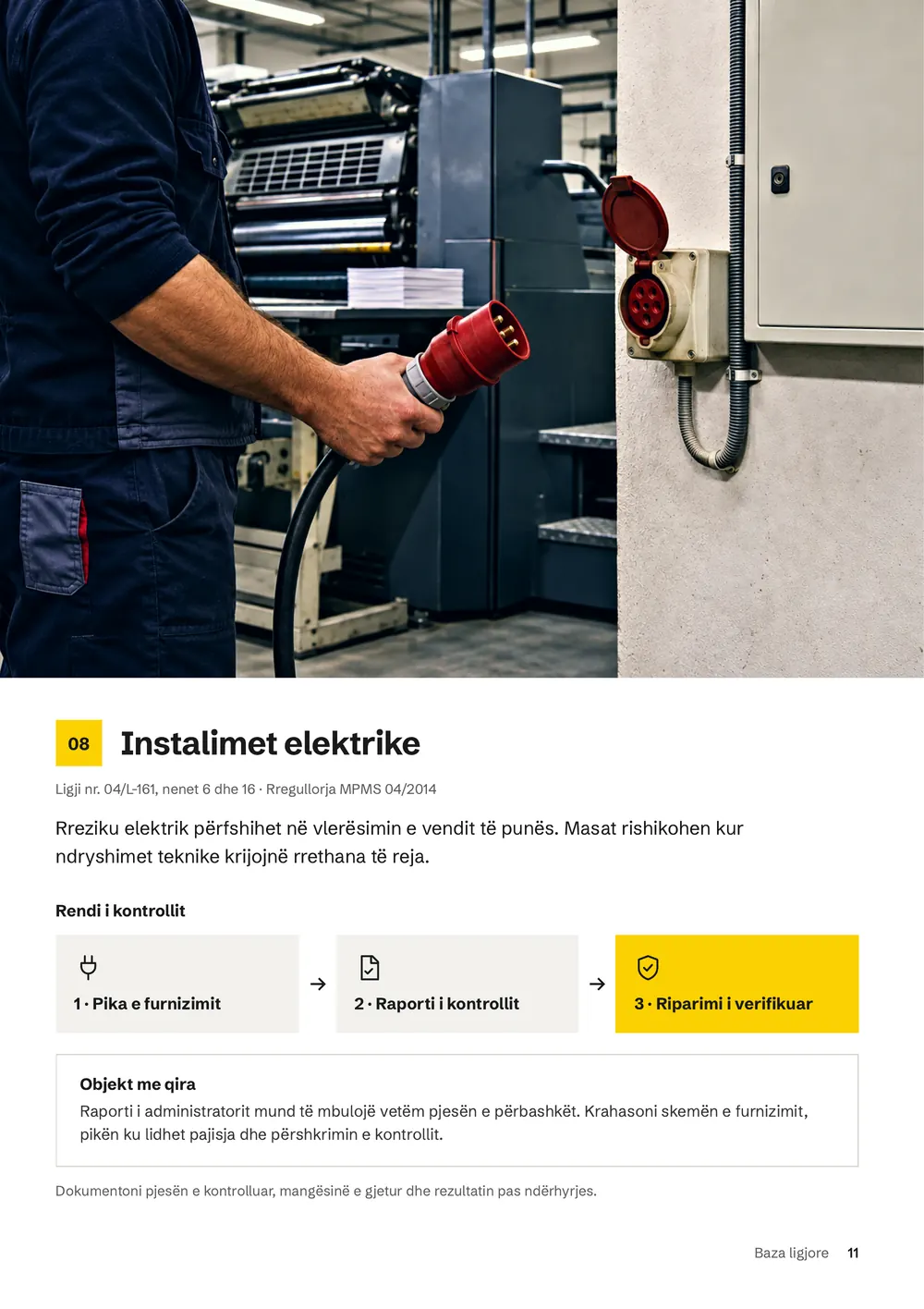
08 · Electrical installations
Law No. 04/L-161, Articles 6 and 16 · MLSW Regulation 04/2014
Electrical risk is included in the workplace assessment. The measures are reviewed when technical changes create new circumstances.
Order of the inspection: 1. Supply point; 2. Inspection report; 3. Verified repair.
Rented premises: The building manager’s report may cover only the shared part. Compare the supply diagram, the point where the equipment is connected and the description of the inspection.
Document the part inspected, the defect found and the result after the work.
Page 12
09 · Signs and clear routes
Law No. 04/L-161, Article 13, para. 1.2 · Article 15, paras. 1.3–1.4 · MLSW Regulation 04/2016
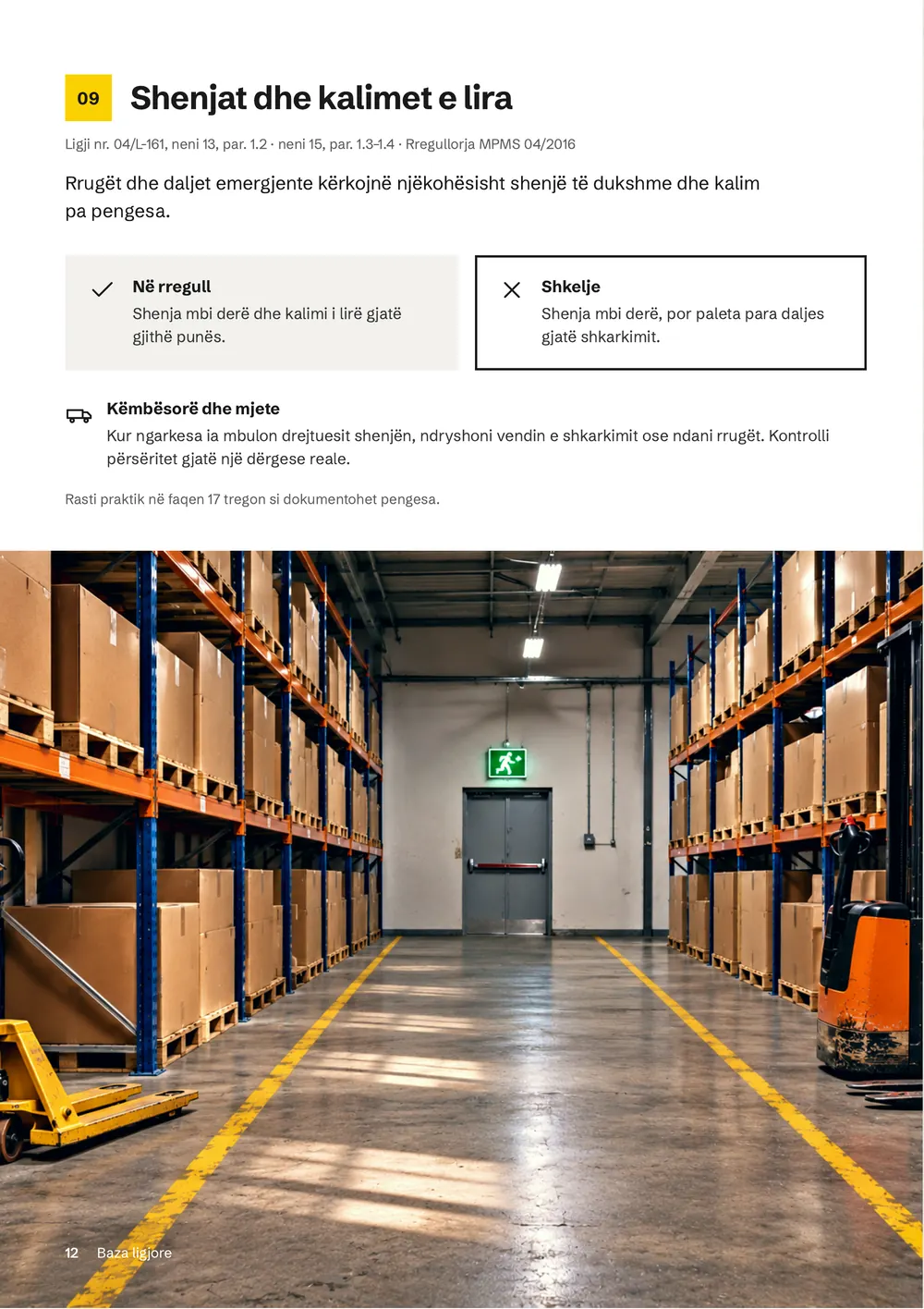
Emergency routes and exits need both a visible sign and an unobstructed path.
Correct: A sign above the door and a clear path throughout the work.
Breach: A sign above the door, but a pallet in front of the exit during unloading.
Pedestrians and vehicles: When the load hides the sign from the driver, change the unloading spot or separate the routes. The check is repeated during a real delivery.
The case study on page 17 shows how the obstruction is documented.
Page 13
10 · Emergency equipment
Law No. 04/L-161, Article 13, paras. 1.10–1.14 · Article 15, para. 1.5
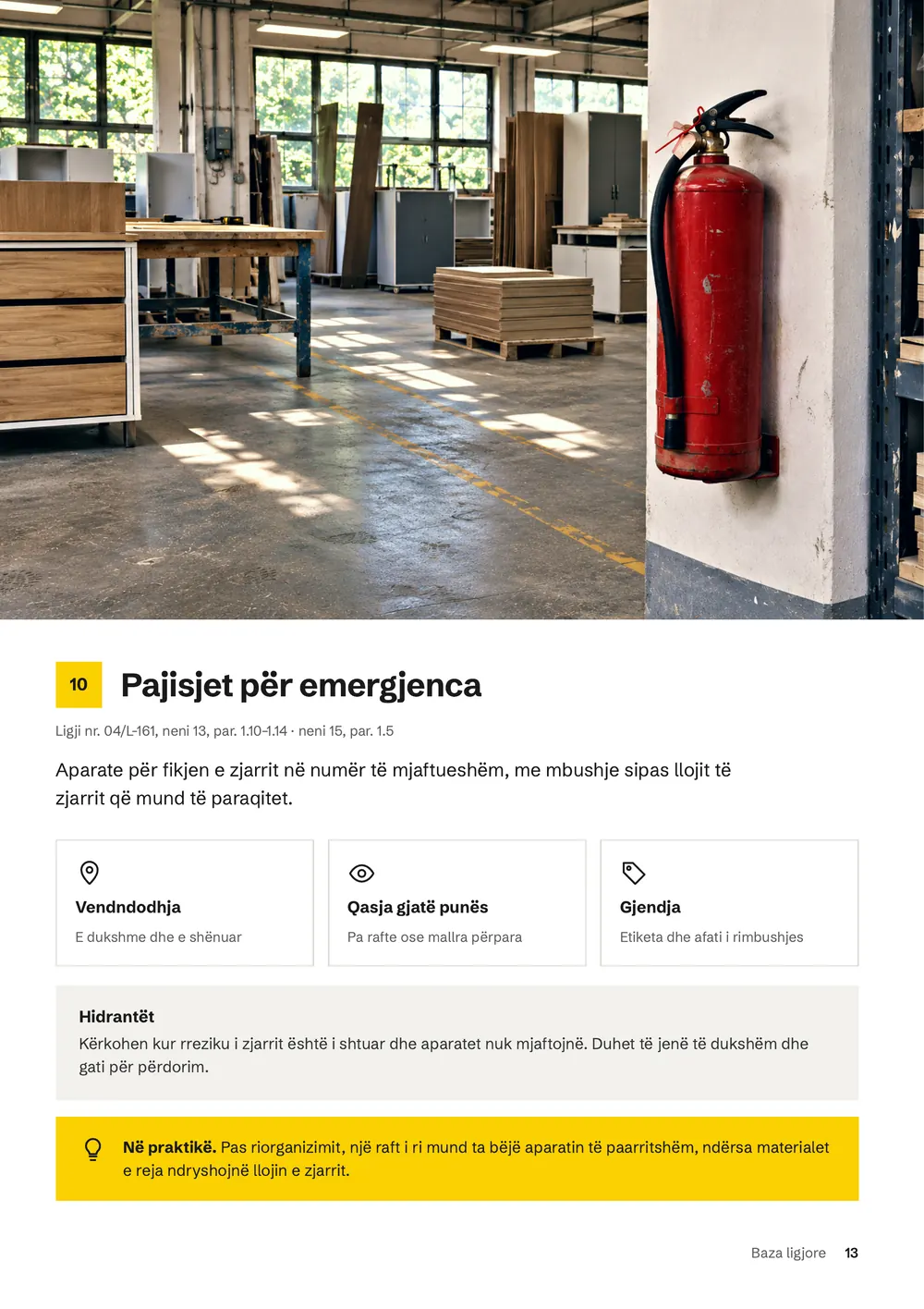
Enough fire extinguishers, with an extinguishing agent suited to the type of fire that may occur.
Location: visible and marked. Access during work: no shelves or goods in front. Condition: label and refill date.
Hydrants: Required when the fire risk is increased and extinguishers are not enough. They must be visible and ready for use.
In practice. After a reorganisation, a new shelf can put an extinguisher out of reach, while new materials change the type of fire.
Page 14
11 · Reporting an accident
Law No. 04/L-161, Article 13, para. 1.9 · Article 16, paras. 5–6 · Article 23, paras. 1–3
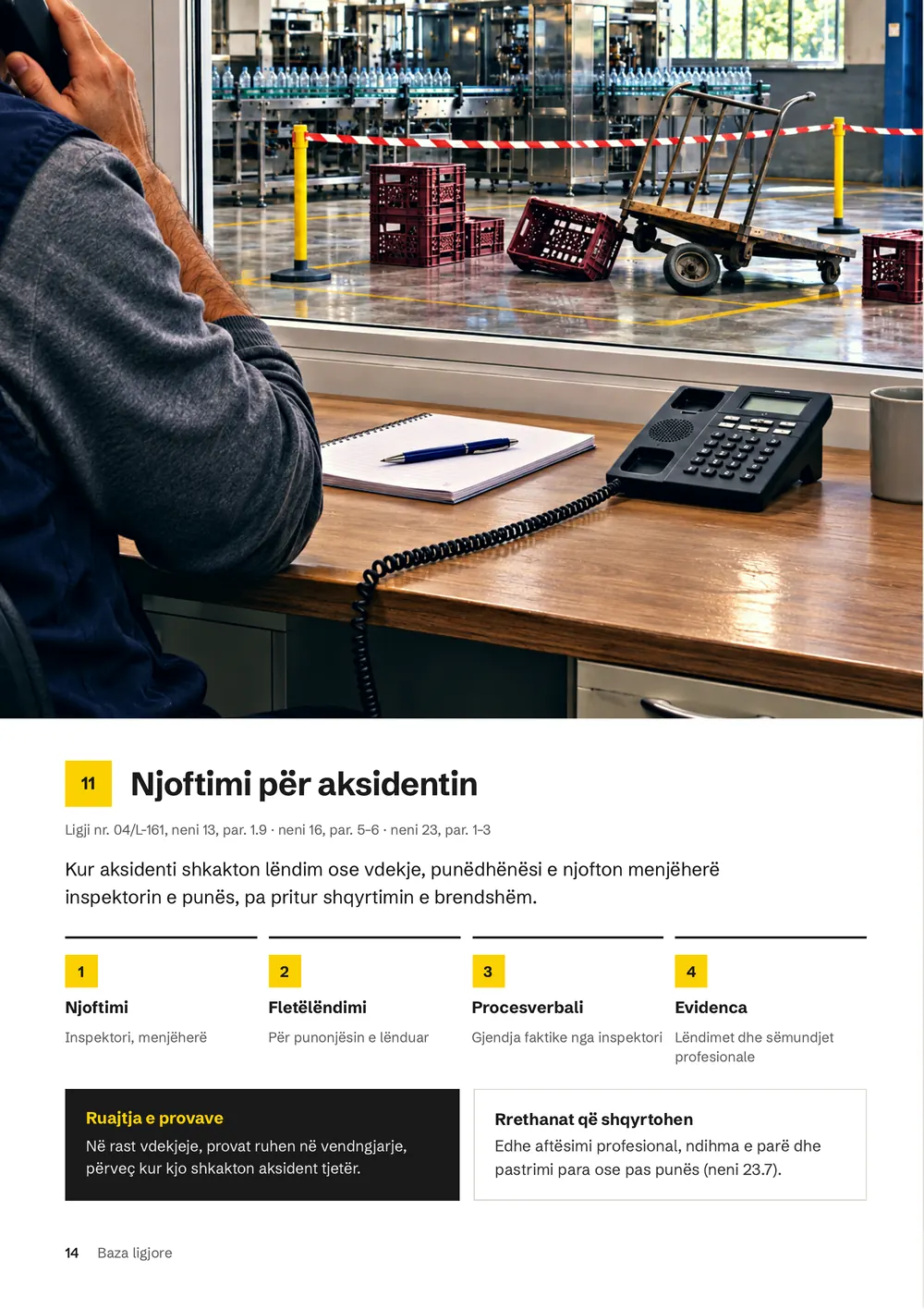
When an accident causes injury or death, the employer notifies the labour inspector immediately, without waiting for the internal review.
1. Notification: the inspector, immediately. 2. Injury report: for the injured employee. 3. Official record: the facts as established by the inspector. 4. Register: injuries and occupational diseases.
Preserving evidence: In the event of a death, evidence is preserved at the scene, unless this would cause another accident.
Circumstances examined: Including vocational training, first aid and cleaning before or after work (Article 23.7).
Page 15
12 · The labour inspector’s measures
Law No. 04/L-161, Article 23, paras. 4–6 · Article 24
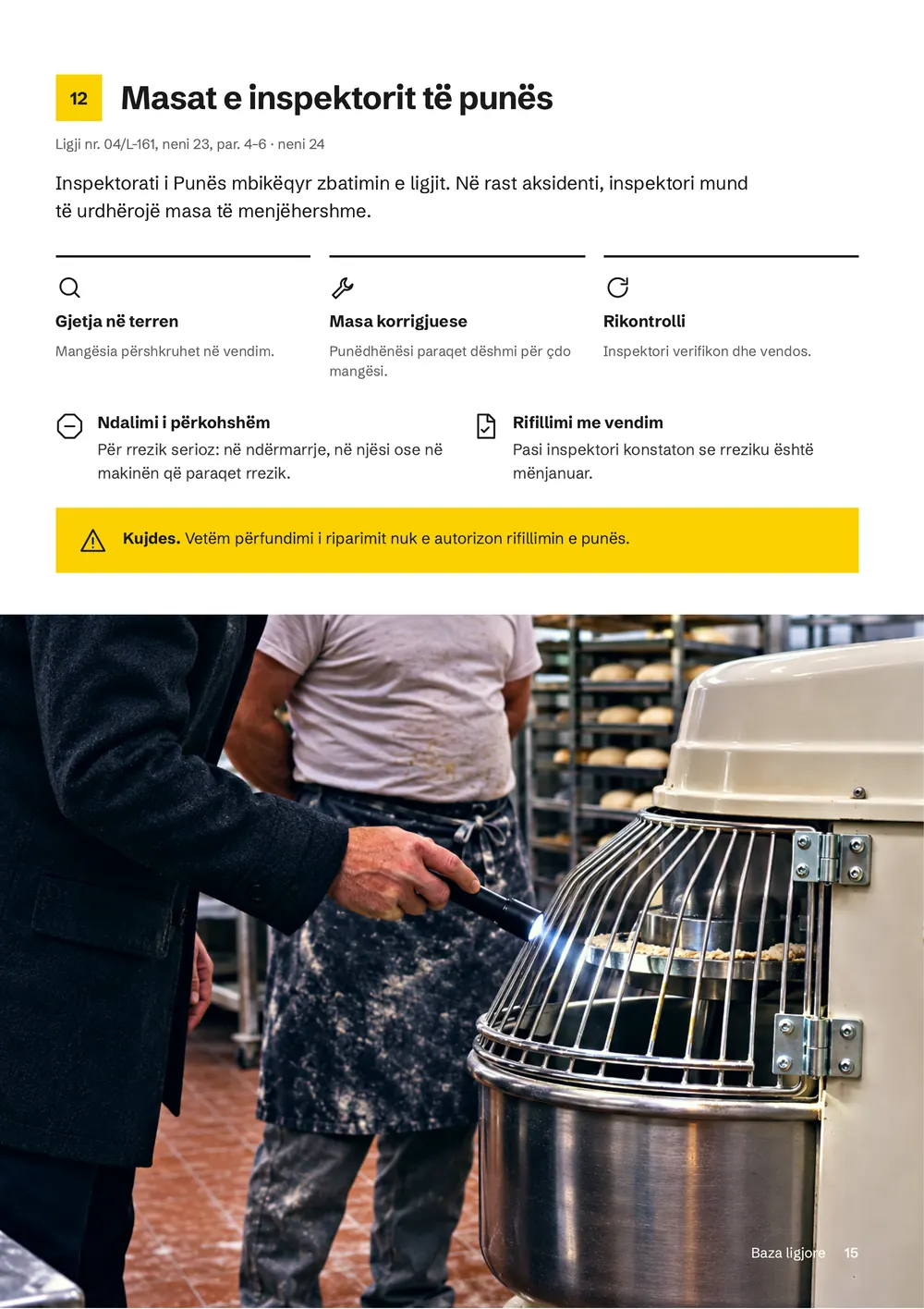
The Labour Inspectorate supervises how the law is applied. After an accident, the inspector may order immediate measures.
Finding on site: The defect is described in a decision. Corrective measure: The employer provides evidence for each defect. Follow-up inspection: The inspector verifies and decides.
Temporary stoppage: For serious danger: in the company, in a unit or on the machine that poses the danger.
Restart by decision: Once the inspector finds that the danger has been removed.
Caution. Finishing the repair alone does not authorise restarting work.
Page 16
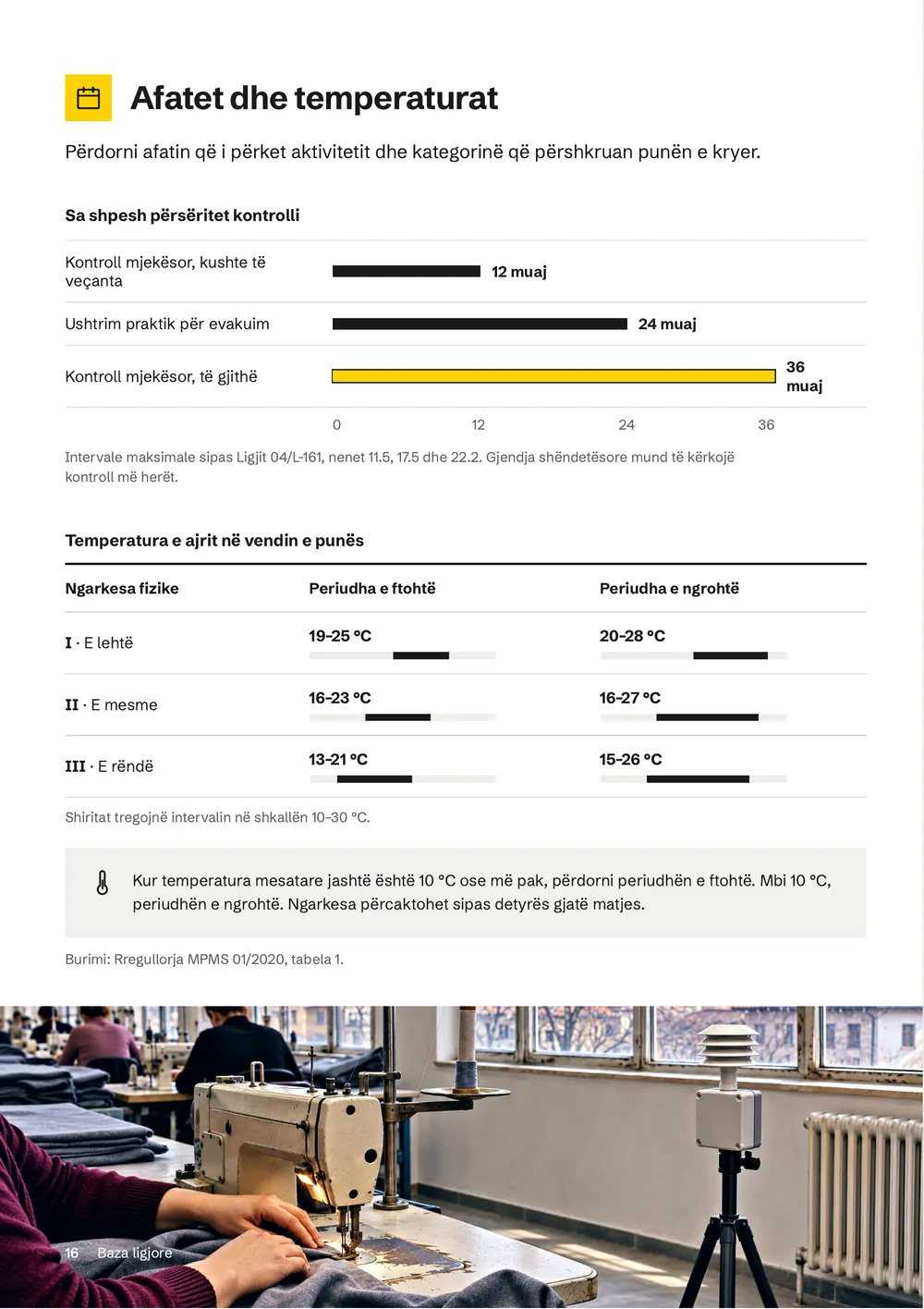
Intervals and temperatures
Use the interval that applies to the activity and the category that describes the work done.
How often the check is repeated: Medical check, special conditions: 12 months. Practical evacuation drill: 24 months. Medical check, all employees: 36 months.
Maximum intervals under Law 04/L-161, Articles 11.5, 17.5 and 22.2. An employee’s health may require an earlier check.
Air temperature at the workplace (cold period / warm period): I · Light: 19–25 °C / 20–28 °C. II · Moderate: 16–23 °C / 16–27 °C. III · Heavy: 13–21 °C / 15–26 °C.
When the average outdoor temperature is 10 °C or below, use the cold period; above 10 °C, the warm period. The workload is set by the task during the measurement.
Source: MLSW Regulation 01/2020, table 1.
Page 17
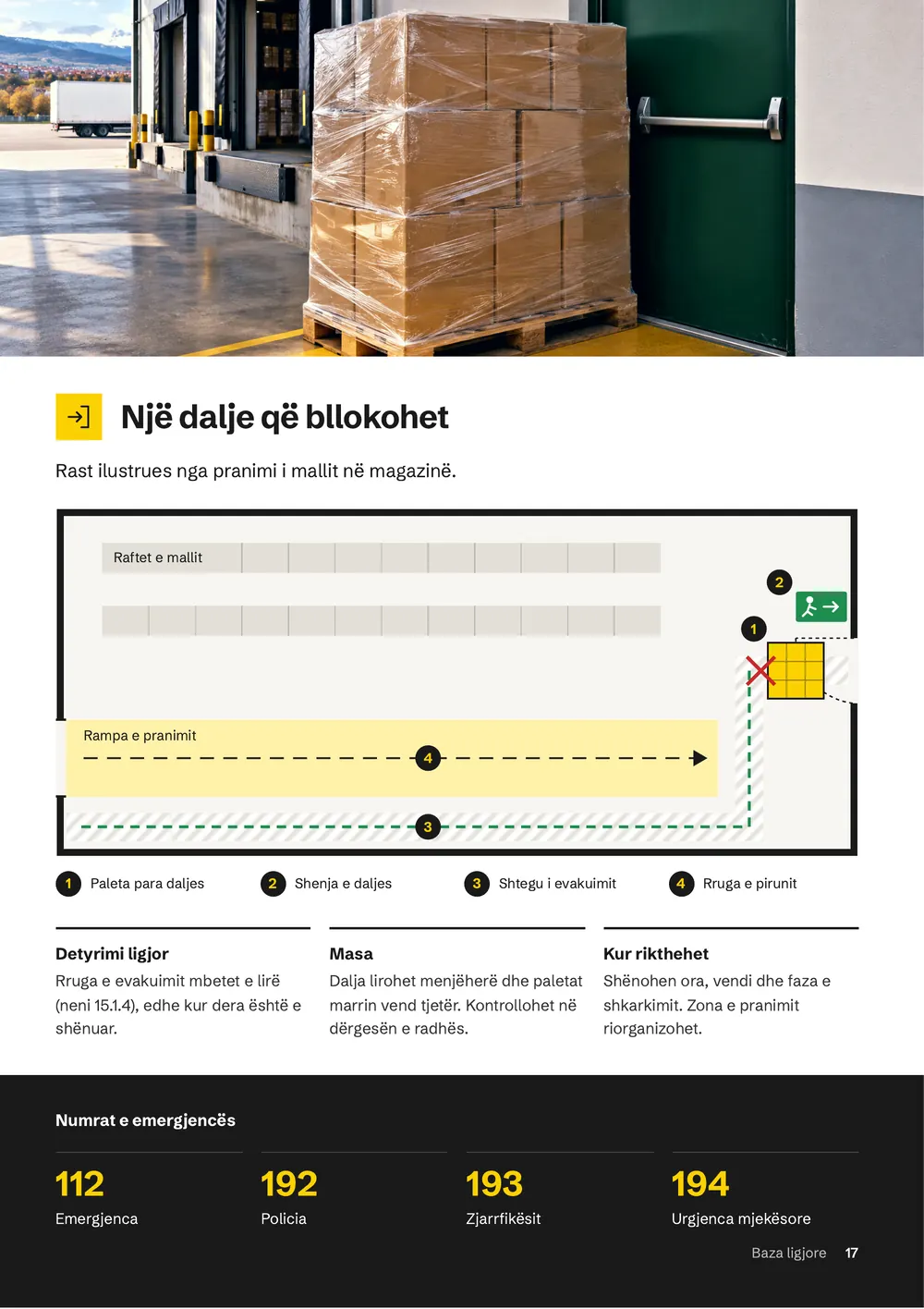
An exit that gets blocked
An illustrative case from goods receiving in a warehouse.
Diagram: storage shelves, receiving ramp, (1) pallet in front of the exit, (2) exit sign, (3) evacuation path, (4) forklift route.
Legal duty: The evacuation route stays clear (Article 15.1.4), even when the door is marked.
Measure: The exit is cleared immediately and the pallets get another place. It is checked at the next delivery.
If it happens again: The time, place and stage of unloading are recorded. The receiving area is reorganised.
Emergency numbers: 112 Emergency · 192 Police · 193 Fire brigade · 194 Medical emergency
Page 18
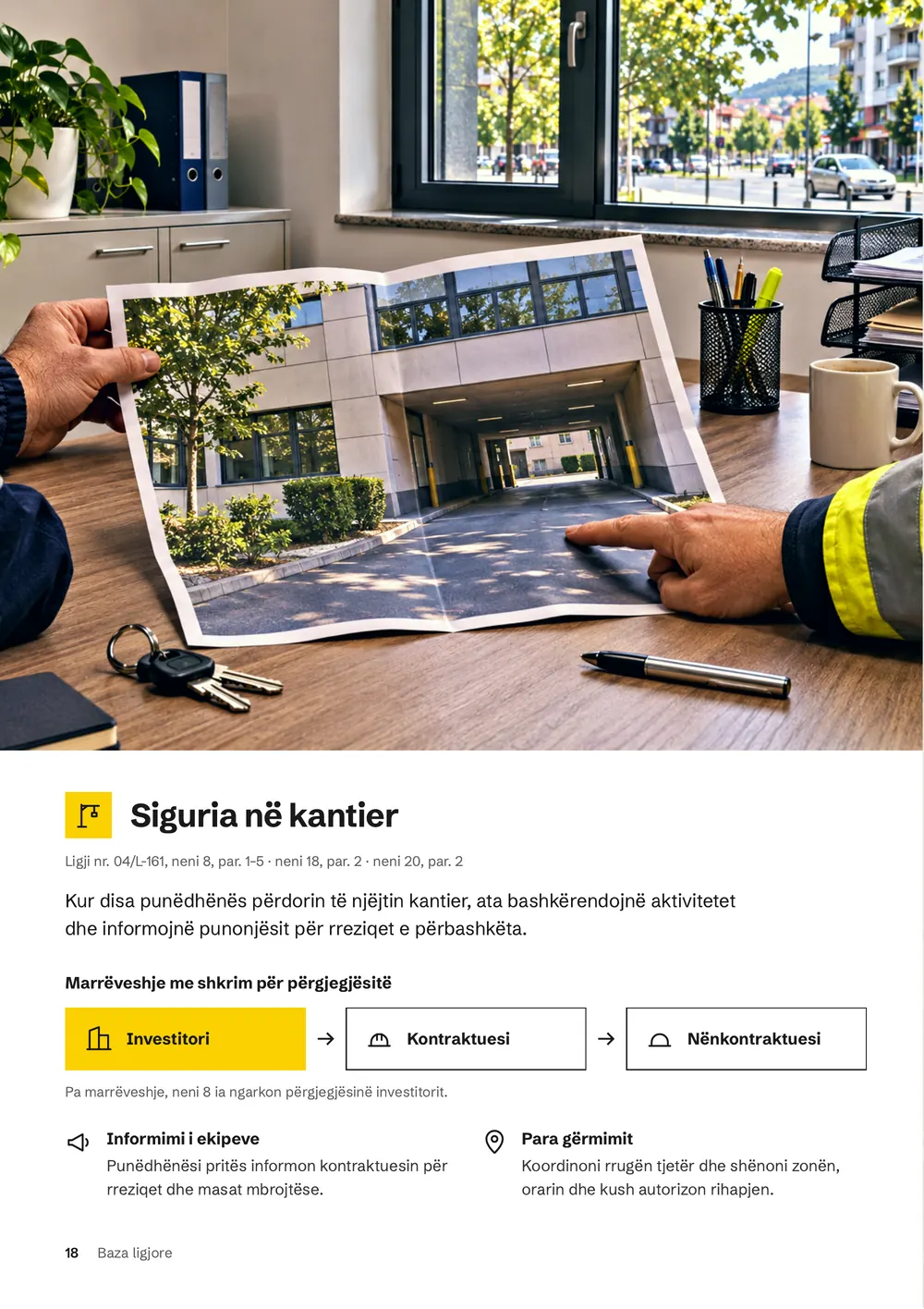
Safety on construction sites
Law No. 04/L-161, Article 8, paras. 1–5 · Article 18, para. 2 · Article 20, para. 2
When several employers use the same site, they coordinate their activities and inform employees about the shared risks.
A written agreement on responsibilities: investor, contractor, subcontractor. Without an agreement, Article 8 places the responsibility on the investor.
Briefing the teams: The host employer informs the contractor about the risks and protective measures.
Before excavation: Coordinate the alternative route and mark the area, the times and who authorises reopening.
Page 19
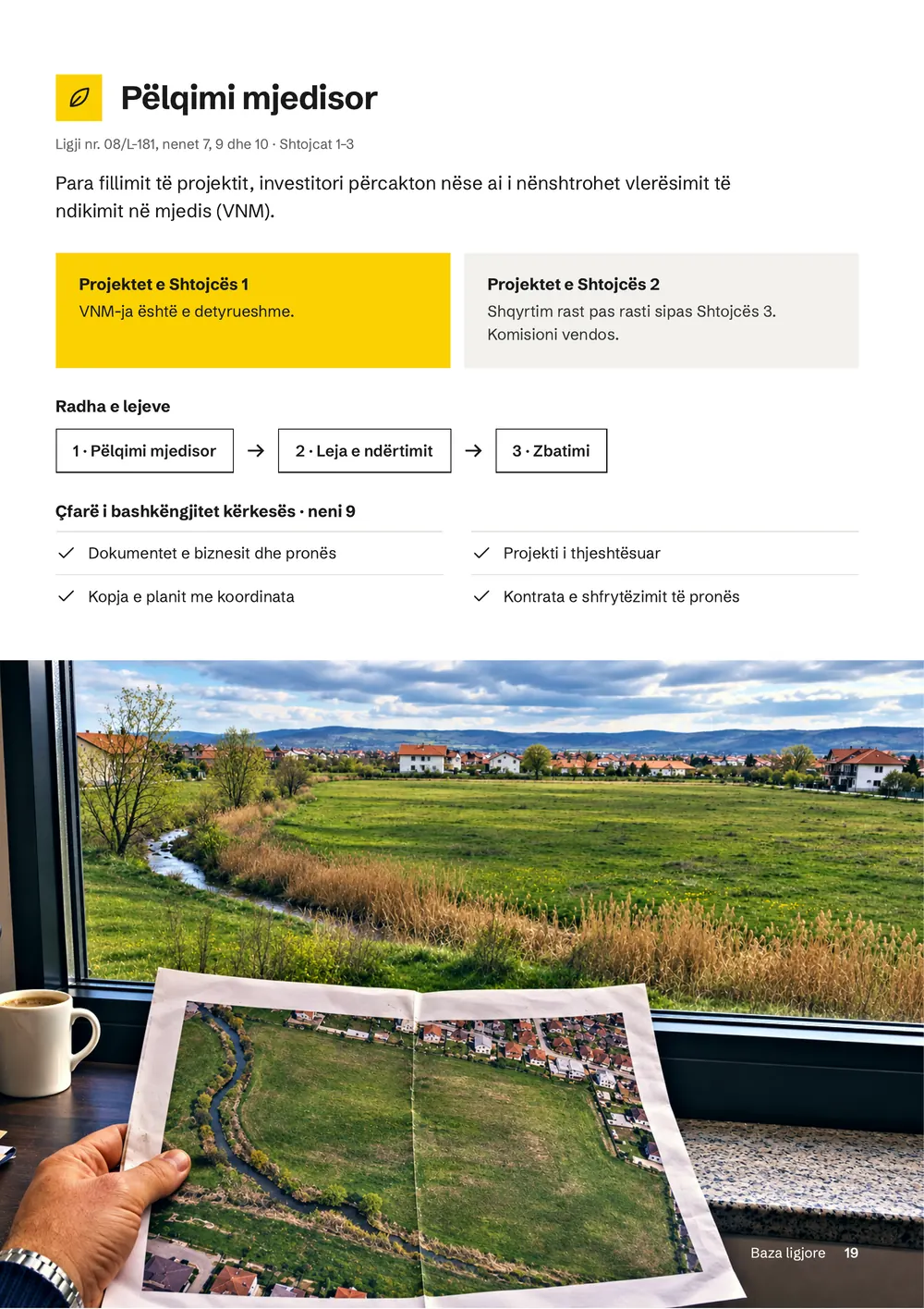
Environmental consent
Law No. 08/L-181, Articles 7, 9 and 10 · Annexes 1–3
Before the project starts, the investor determines whether it is subject to an environmental impact assessment (EIA).
Annex 1 projects: An EIA is mandatory.
Annex 2 projects: Case-by-case screening under Annex 3. The commission decides.
Order of permits: 1. Environmental consent; 2. Building permit; 3. Construction.
What is attached to the application (Article 9): business and property documents; the simplified design; a copy of the plan with coordinates; the property use contract.
Page 20
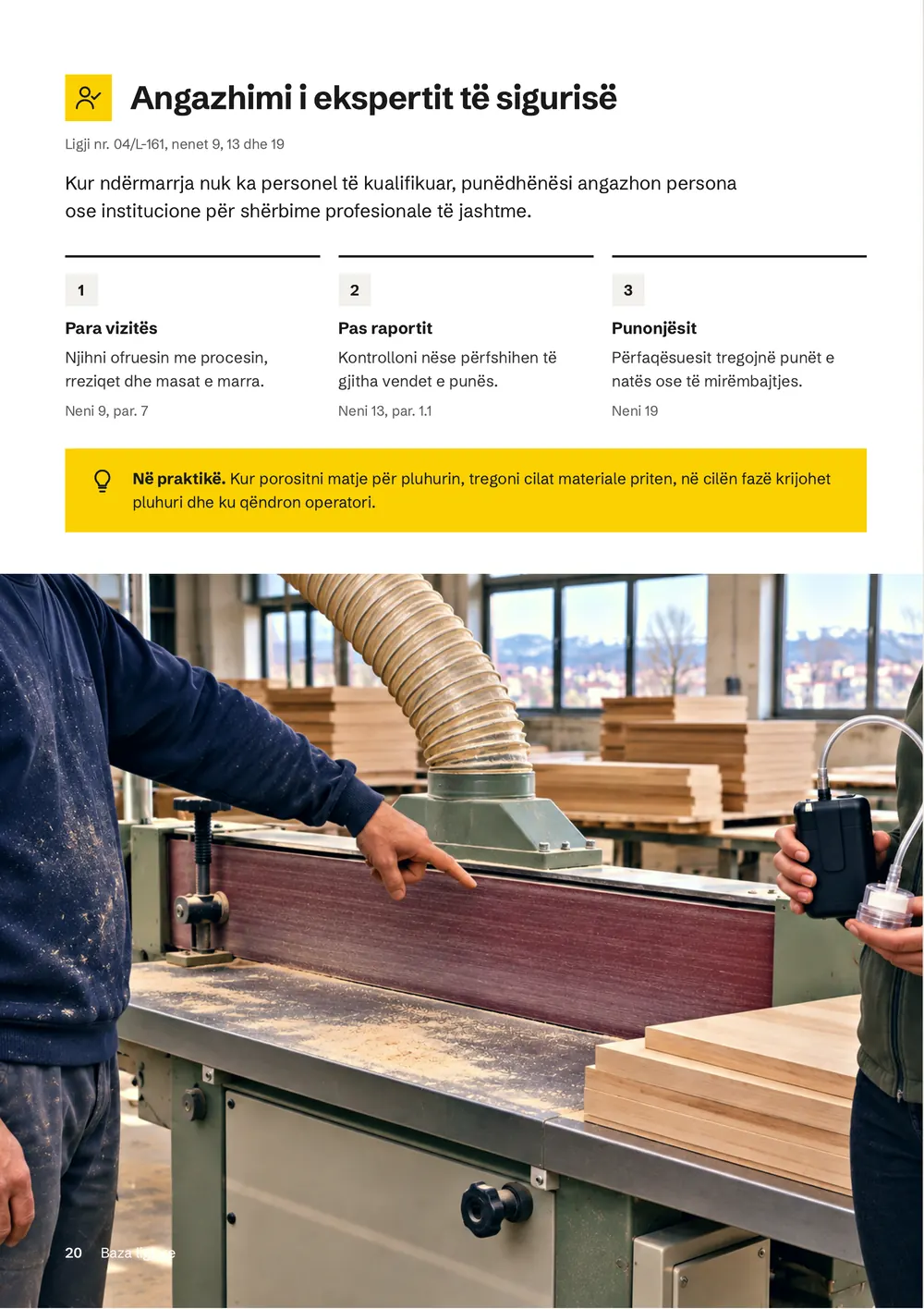
Engaging a safety expert
Law No. 04/L-161, Articles 9, 13 and 19
When the company has no qualified staff, the employer engages people or institutions for external professional services.
1. Before the visit: Brief the provider on the process, the risks and the measures already taken (Article 9, para. 7).
2. After the report: Check that all workplaces are covered (Article 13, para. 1.1).
3. Employees: Representatives point out night or maintenance work (Article 19).
In practice. When you order dust measurements, say which materials are cut, at which stage the dust is produced and where the operator stands.
Page 21
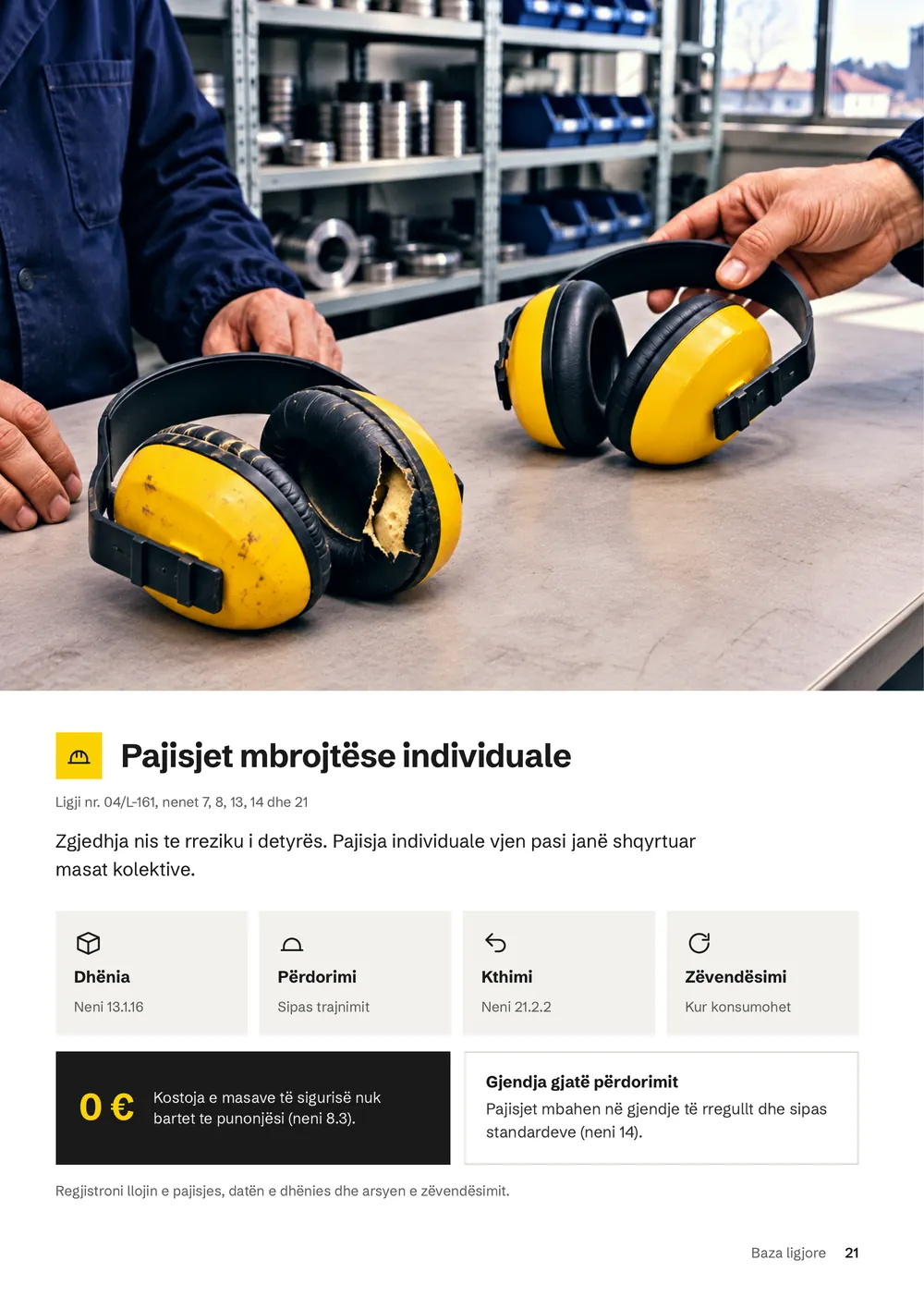
Personal protective equipment
Law No. 04/L-161, Articles 7, 8, 13, 14 and 21
The choice starts from the risk of the task. Personal equipment comes after collective measures have been considered.
Issue: Article 13.1.16. Use: as trained. Return: Article 21.2.2. Replacement: when worn out.
€0: The cost of safety measures is not passed on to the employee (Article 8.3).
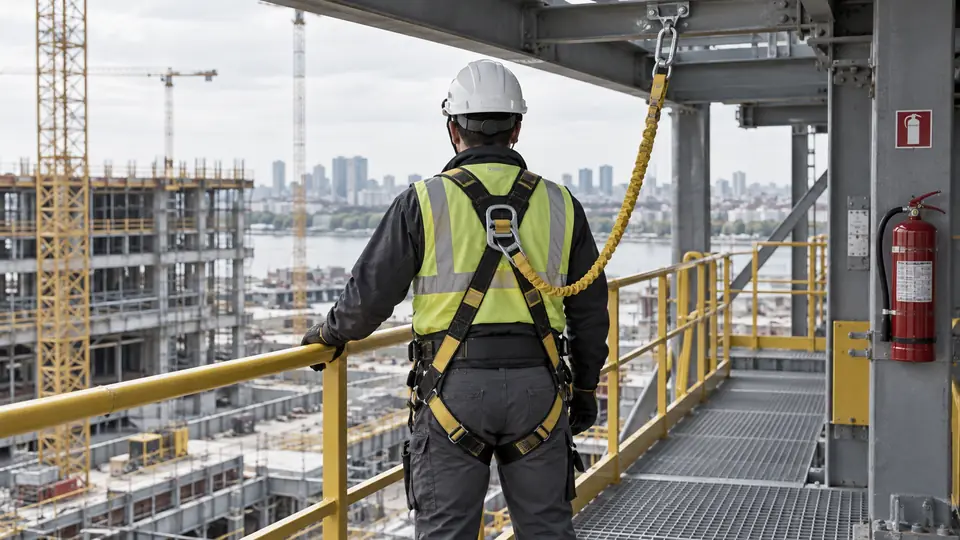
Condition during use: The equipment is kept in good order and to standard (Article 14).
Record the type of equipment, the date it was issued and the reason for replacement.
Page 22
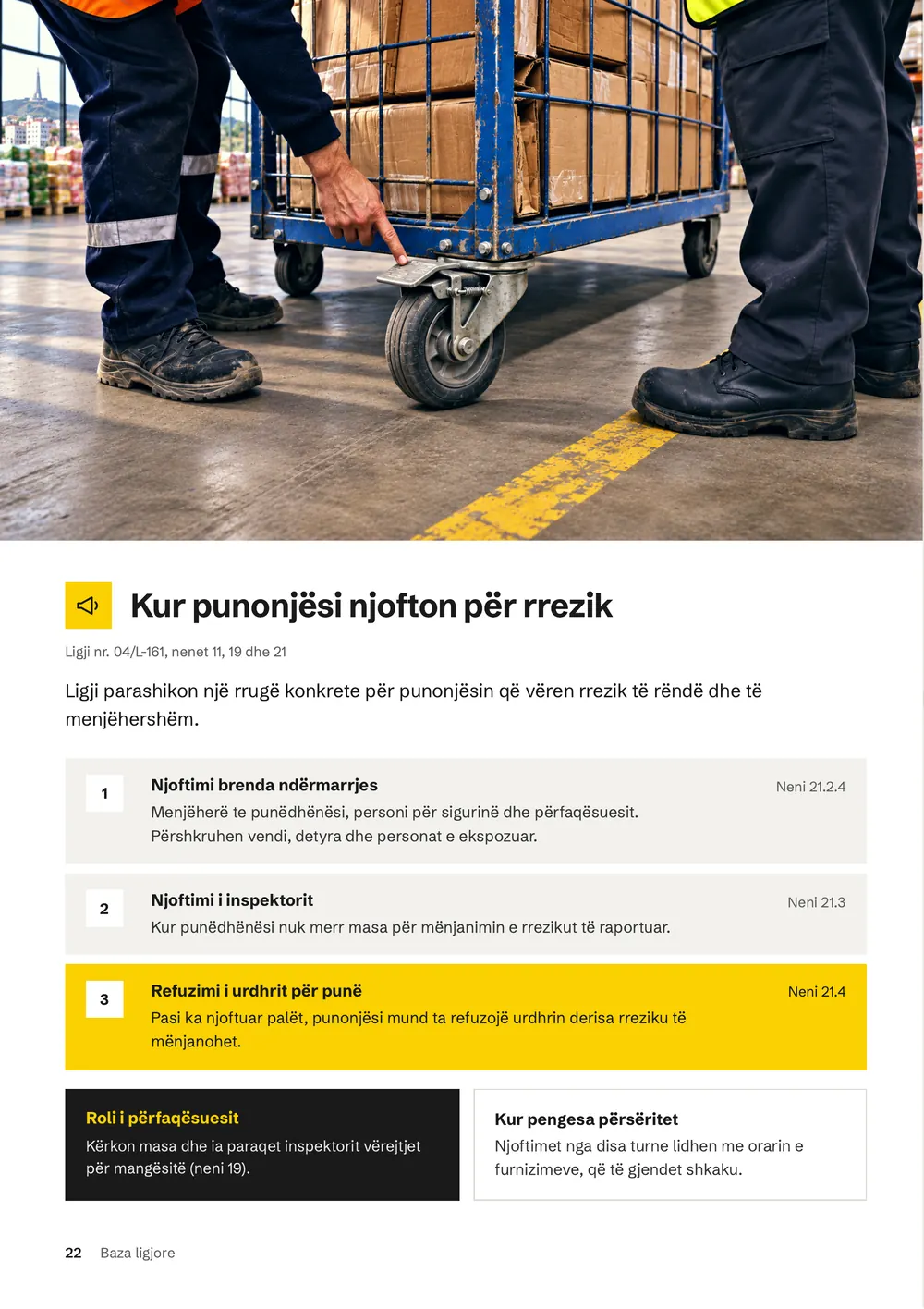
When an employee reports a hazard
Law No. 04/L-161, Articles 11, 19 and 21
The law sets out a concrete path for an employee who notices a serious and immediate danger.
1. Reporting within the company (Article 21.2.4): Immediately to the employer, the safety officer and the representatives. The place, the task and the people exposed are described.
2. Notifying the inspector (Article 21.3): When the employer takes no measures to remove the reported danger.
3. Refusing a work order (Article 21.4): Having notified the parties, the employee may refuse the order until the danger is removed.
The representative’s role: Requests measures and submits remarks on the shortcomings to the inspector (Article 19).
When the obstruction recurs: Reports from several shifts are linked to the delivery schedule to find the cause.
Page 23
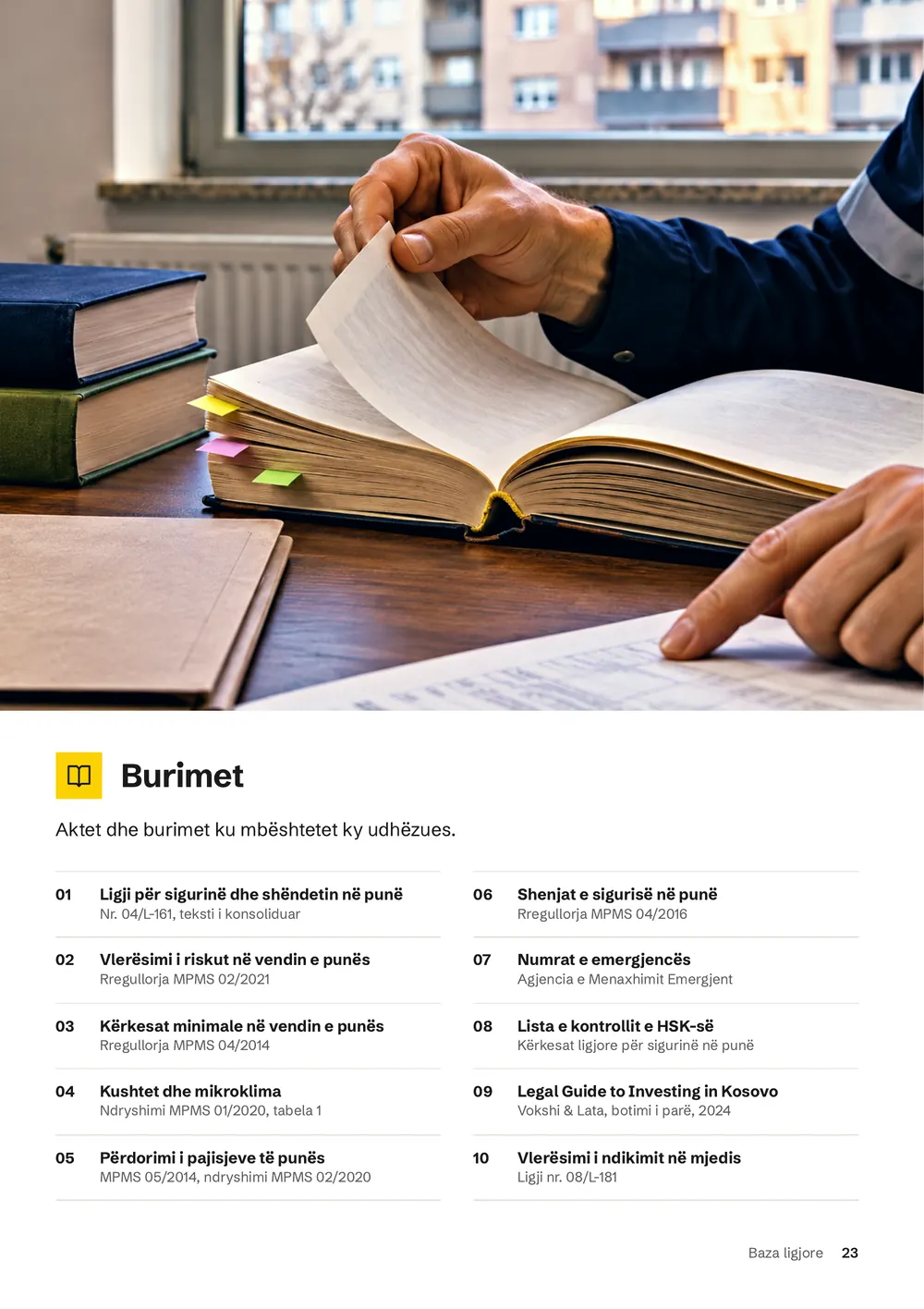
Sources
The acts and sources this guide is based on.
01 Law on Safety and Health at Work: No. 04/L-161, consolidated text.
02 Risk assessment at the workplace: MLSW Regulation 02/2021.
03 Minimum requirements at the workplace: MLSW Regulation 04/2014.
04 Conditions and microclimate: MLSW amendment 01/2020, table 1.
05 Use of work equipment: MLSW 05/2014, amended by MLSW 02/2020.
06 Safety signs at work: MLSW Regulation 04/2016.
07 Emergency numbers: Emergency Management Agency.
08 HSK checklist: Legal requirements for safety at work.
09 Legal Guide to Investing in Kosovo: Vokshi & Lata, first edition, 2024.
10 Environmental impact assessment: Law No. 08/L-181.
Page 24
HEALTH AND SAFETY AT WORK
Safer workplaces. Clearer responsibility.
HSK: Occupational safety and health services since 2017. Ulpiana, C7/1, 10000 Prishtina, Kosovo.
HSK Training Centre: Safety at work, fire protection, construction safety and OHS specialist. Rruga Ali Vitia, Kalabria neighbourhood, 10000 Prishtina, Kosovo.
Google reviews: Scan the code and leave us a review of HSK’s services. Scan the code and rate the training you attended.
Phone: +383 44 170 670 · +383 49 862 834 · +383 49 548 271
Email: info@hsk-ks.com · Website: hsk-ks.com
Want a guide for your own workplace?
We prepare instructions and training built on your organisation’s risks.